

Vacation rental market in 2026 Key figures, trends and outlook for France and Europe
By Nicolas Schiavon — Founder of Metadosi and SEO and Growth Marketing consultant with more than 15 years of experience. Updated September 2026.
I am Nicolas Schiavon, founder of Metadosi. For more than 15 years, I have helped businesses with search engine optimisation and digital customer acquisition. My work with tourism, hospitality and vacation rental businesses has taught me one thing: growth in a market never guarantees growth for every operator.
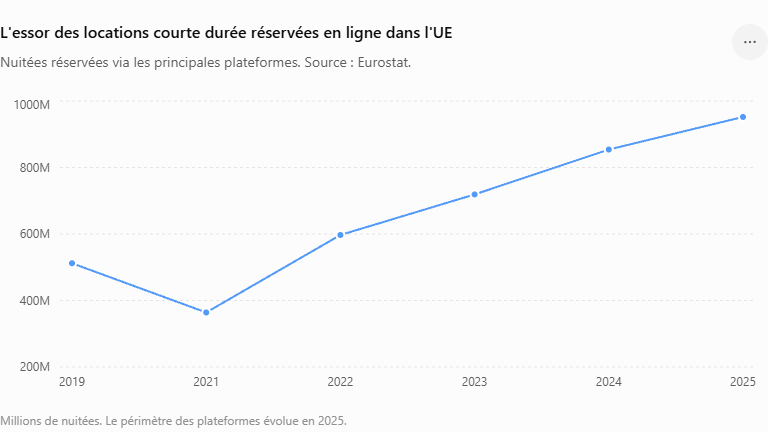
Vacation rentals are no longer a niche market. In 2025, travellers spent 951.6 million guest nights in short-stay accommodation booked through Airbnb, Booking or Expedia in the European Union. That volume increased by 11.4% year on year and by 32.4% compared with 2023. France plays a central role in this growth: it is the largest EU market on these platforms, with approximately 213 million guest nights in 2025.
In this article, I deliberately distinguish market data from my operational analysis. The figures come primarily from Eurostat and Atout France. My interpretation draws on the strategies I implement at Metadosi, particularly in Alpine hospitality. My aim is to help you understand where demand comes from, how it is changing and how to capture it profitably.
The vacation rental market in seven figures
| Indicator | Value | Interpretation |
| EU guest nights booked through major platforms | 951.6 million in 2025 | A record, up 11.4% year on year |
| Guest nights in France through these platforms | Approximately 213 million in 2025 | France is the largest EU market |
| France’s share | Approximately 22% of the EU total | Roughly one in five EU guest nights |
| France, Spain and Italy | 56.8% of the EU total | Strong concentration in southern Europe |
| EU growth since 2023 | +32.4% | Rapid growth over two years |
| French residents’ guest nights in paid holiday rentals | +6.6% in 2025 | Faster growth than paid accommodation overall |
| Total tourism guest nights in France | 743 million in 2025 | A supportive national tourism environment |
Important: these figures do not all cover the same scope. Eurostat’s figures concern bookings through Airbnb, Booking and Expedia, whereas Atout France’s figures cover broader categories of accommodation. They must not be added together.
The six largest markets in the European Union
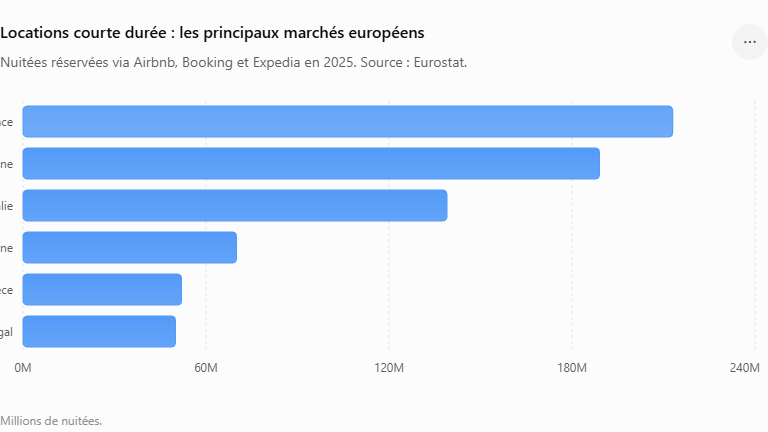
| Country | Guest nights in 2025 | Approximate share of the EU total |
| France | 213 million | 22.4% |
| Spain | 189 million | 19.9% |
| Italy | 139 million | 14.6% |
| Germany | 70 million | 7.4% |
| Greece | 52 million | 5.5% |
| Portugal | 50 million | 5.3% |
France, Spain and Italy account for 56.8% of guest nights recorded through the platforms monitored by Eurostat. Shares are calculated against a total of 951.6 million guest nights. National figures and the resulting shares are rounded.
France leads the European online short term rental market
With approximately 213 million guest nights recorded in 2025 through the three major platforms monitored by Eurostat, France is ahead of Spain, at 189 million, and Italy, at 139 million. Germany, Greece and Portugal follow.
France alone accounts for nearly 22% of short-stay guest nights measured on these platforms in the EU. Together with Spain and Italy, it forms a trio representing 56.8% of European volume. This position reflects the diversity of French accommodation: coastal areas, mountains, major cities, rural destinations and overseas territories cater to very different guests and seasons.
Growth is not limited to international visitors. Atout France estimates that French residents’ guest nights in paid holiday rentals increased by 6.6% in 2025. Over the full year, France welcomed 102 million international tourists and recorded 743 million guest nights in paid and non-paid accommodation.
A European market approaching one billion guest nights
The symbolic one-billion mark is now close. The 951.6 million guest nights booked online in the EU in 2025 represent an increase of 11.4% compared with 2024 and 32.4% compared with 2023.
The post-pandemic rebound has developed into structural growth. Travellers use short-term rentals for a wide range of purposes: family holidays, city breaks, remote working, events, winter sports and extended business trips. Meanwhile, supply has become more professional. Many properties are now managed by vacation rental management companies, multi-property operators or owners using distribution tools and dynamic pricing.
The market nevertheless remains geographically concentrated. In the third quarter of 2025, the most popular regions on these platforms were Croatia’s Adriatic coast, Andalusia and Provence-Alpes-Côte d’Azur. Six French regions ranked among the EU’s top twenty, confirming the depth and diversity of demand in France.
Can we measure the size of the global market
Global estimates expressed in billions of euros or dollars need to be treated with caution. Depending on the study, the market may include only entire-home rentals, also cover rooms in private homes or holiday residences, or measure online transactions alone. The terms vacation rental, short-term rental and alternative accommodation do not always describe the same market.
The most reliable indicators for analysing the global market therefore remain platform-reported volumes, guest nights tracked by statistical agencies and operational metrics such as occupancy, average nightly rate and revenue per available property. For a business operating in France, European data is often more useful than an impressive but hard-to-verify global estimate: it directly informs decisions about reachable source markets, seasonality and competition.
Trends reshaping vacation rentals in 2026
Strong but more selective demand
Growth in guest nights does not mean every property is easy to fill. Travellers increasingly compare amenities, location, cancellation terms, reviews and photography. A generic offering quickly competes with dozens of similar properties. Differentiation becomes a driver of conversion as much as a pricing issue.
Major platforms still dominate distribution
Airbnb, Booking and Expedia provide substantial audiences and reassuring booking infrastructure. They are often a property’s first acquisition channel. That reach comes with trade-offs: commissions, imposed rules, exposure to algorithm changes and limited control over the guest relationship.
The realistic objective is not necessarily to leave the platforms, but to reduce dependence on them. A multichannel strategy combines online travel agencies (OTAs) for reach, a high-performing website for direct bookings, SEO for qualified demand and email to retain satisfied guests.
Revenue management is now driven by data
High occupancy alone does not prove profitability. A property can be fully booked after selling too early or too cheaply. Conversely, excessive price increases can reduce booking volume, visibility and review scores. Professional operators therefore track average nightly rate, occupancy, average length of stay, booking lead time and revenue per available property together.
Seasonality requires year round work
In France, the third quarter still accounts for 43% of residents’ guest nights in paid accommodation. Yet growth opportunities often lie in the shoulder seasons. International guests, local events, short breaks and content about visiting a destination outside peak season can extend the commercial window. For a mountain resort, hiking, cycling, gastronomy and wellness can complement the ski season.
Regulation becomes a strategic consideration
In France, local authorities have increasing powers to regulate furnished tourist accommodation, including registration, changes of use, limits on rental duration for certain primary residences, co-ownership rules and energy performance requirements. Obligations vary by property and municipality. Before investing in acquisition, pricing or advertising, operators should check local and tax compliance with official sources and their advisers.
What these changes mean for owners and property managers
The market remains attractive, but increasingly rewards operators who manage the entire guest journey. Performance depends on four balances.
- Visibility and margin. Platforms generate demand quickly, while direct bookings reduce commissions and build a lasting marketing asset.
- Occupancy and pricing. Filling the calendar is not the only objective: each period needs to be sold at the best rate demand will support.
- Acquisition and retention. Acquiring a new guest costs more than re-engaging a satisfied previous customer.
- Standardisation and differentiation. Tools automate distribution, but the promise, local experience and brand remain the main reasons guests choose one property over another.
How I interpret market signals
| Market signal | My interpretation | My recommended action |
| European demand is growing | Potential remains high, but competition is growing too | Develop a clear value proposition and target specific searches rather than generic traffic |
| France represents approximately 22% of European volume | A deep domestic market attracts more structured operators | Benchmark performance against the local micro-market, not a national average |
| Platforms concentrate distribution | They remain useful but create dependency risk | Develop direct bookings, SEO and the customer database in parallel |
| The third quarter remains dominant | Quieter periods offer the main growth opportunity | Create offers and content for the shoulder seasons |
| Regulation is tightening | Compliance now affects strategy and profitability | Check local rules before spending on acquisition |
Why I consider SEO a strategic channel
Travellers’ searches are increasingly specific: family chalet in Courchevel, villa with a pool in the Var, apartment near the slopes or group holiday cottage in Savoie. These queries express strong intent, and platforms are not the only businesses able to capture it.
In my work at Metadosi, I do not pursue traffic for its own sake. I build pages around destinations, property types and travellers’ actual expectations. SEO should serve three measurable objectives: generate qualified enquiries, increase the share of direct bookings and gradually reduce dependence on intermediaries.
To turn market analysis into an action plan, read our guide to digital marketing for vacation rentals (in French). It covers distribution, content, SEO and retention strategies for owners and managers.
The commercial calendar also needs to suit each period. Our advice on seasonal marketing for apartment rentals (in French) explains how to support demand in both peak season and quieter periods.
My experience with Chalet Le Persan in Courchevel
This is not a theoretical issue. For Chalet Le Persan in Courchevel, I led a strategy combining brand positioning, intent-based content architecture, multilingual SEO and channel diversification. I did not try to outspend major agencies on advertising. I focused on searches with strong commercial value and consistent branding.
Between the 2025 and 2026 winter seasons, rental revenue increased by 94%. April bookings rose by 216%, and nearly 30% of qualified traffic came from sources other than Google by the end of the season. These are Metadosi client figures specific to this case: they illustrate an approach, not a promise of identical results for every property.
| Metric | Winter 2025 | Winter 2026 | Observed change |
| Rental revenue | Index 100 | Index 194 | +94% |
| April bookings | Index 100 | Index 316 | +216% |
| Qualified traffic from sources other than Google | Less than 10% | Approximately 30% | Reduced dependence |
| International reach | Limited | Stronger | Multilingual SEO active |
Source: Metadosi client data, Chalet Le Persan, 2024/2025 and 2025/2026 seasons.
Explore the approach in the Chalet Le Persan in Courchevel case study (in French).
How I build a strategy for the 2026 market
- 1 I establish the baseline : I start with revenue by channel, commissions, occupancy, average nightly rate, booking lead time, cancellations and the proportion of returning guests. Without this baseline, improvements cannot be attributed accurately.
- 2 I map demand : I identify the most profitable geographical markets, periods and reasons for travel. Market-wide data provides context; property-specific data determines decisions.
- 3 I clarify the positioning : A property cannot be the best choice for everyone. I define the priority guest, the promise, supporting evidence and differentiators before producing pages or campaigns.
- 4 I diversify channels : I retain useful platforms while developing a fast website, targeted SEO pages, a consent-based email database and local partnerships.
- 5 I manage revenue and content : I adjust prices, minimum stays, offers and content according to demand, events and the actual booking pace.
- 6 I measure real profitability : I attribute bookings to channels and compare the total acquisition cost. A direct booking is advantageous only if marketing and management costs remain under control.
Outlook for the vacation rental market
The available data points to a market that is still growing, supported by strong European demand and France’s tourism appeal. However, I see professionalisation accelerating. Local rules, guest expectations and competition make improvised strategies less effective.
In my view, the winners will not simply be the best-located properties. They will also be those that understand their market, control distribution, build a recognisable brand and convert visibility into profitable bookings. Marketing is no longer a layer added after a property goes online: it is becoming a core operational function.
Frequently asked questions about the vacation rental market
Is the vacation rental market still growing in 2026
Complete data for 2026 is not yet available. However, the latest consolidated figures show strong momentum: 951.6 million guest nights were booked through Airbnb, Booking and Expedia in the EU in 2025, 11.4% more than in 2024.
Which is the largest European vacation rental market
France leads in guest nights booked through the major platforms monitored by Eurostat, with approximately 213 million in 2025, ahead of Spain and Italy.
Are Airbnb and Booking enough to rent out a property
These platforms provide useful visibility, but I advise against depending on them entirely. Commissions, algorithm changes and limited access to the guest relationship make the business more vulnerable. I recommend a mix of platforms, a direct-booking website, SEO, email and local partners.
Which metrics should I track
At a minimum, I track occupancy, average nightly rate, revenue per available property, length of stay, booking lead time, cancellations, cost or commission by channel and the share of direct bookings. Revenue alone does not explain profitability.
How can I reduce seasonality
I start by identifying genuinely reachable shoulder-season demand: local activities, events, short breaks, remote working or international guests. I then adapt content, offers, minimum stays and re-engagement campaigns.
Conclusion
France holds a leading position in a European market approaching one billion guest nights booked online. My analysis is straightforward: the opportunity is real, but it does not automatically translate into revenue. In a more competitive and regulated environment, performance depends on market knowledge, clear positioning, control over channels and the ability to grow direct bookings.
Do you manage a vacation rental, a rental management business or a property portfolio and want to turn these trends into measurable growth? Contact Metadosi to review your customer acquisition, SEO and direct-booking strategy.
About Nicolas Schiavon
I am Nicolas Schiavon, founder of Metadosi and an SEO and Growth Marketing consultant. With more than 15 years specialising in organic search, I help tourism, hospitality and luxury businesses acquire customers online. At Metadosi, I prioritise data-driven SEO tied to revenue and reduced dependence on platforms.
You can read my full account in the Chalet Le Persan case study (in French).
Sources
- Eurostat, Tourism nights booked via platforms hit nearly 1 billion, 1 April 2026.
- Eurostat, Short-stay accommodation offered via online collaborative economy platforms.
- Atout France, 2025 tourism review, 19 February 2026 (in French).
- Metadosi, Digital marketing for vacation rentals (in French).
- Metadosi, Chalet Le Persan case study (in French).